Why Commercial Properties Need More Than a Standard Storefront Lock
A retail storefront is designed to be seen into, not sealed off. That same open, glass-forward design that draws customers in also gives anyone outside a clear view of the merchandise, registers, and office equipment inside once the lights go off.
Standard storefront locks and glass doors are built for daily convenience, not for resisting a deliberate attempt to get inside after hours. A single point of failure at the front door, whether that is aging hardware or glass that gives way under force, can be enough to expose an entire retail floor or office suite.
Business owners also carry a different kind of risk than homeowners. A break-in during closed hours can mean stolen inventory, damaged fixtures, and lost business days while repairs are made, on top of the security gap itself.
How Commercial Security Screens Work for Storefronts and Office Entries
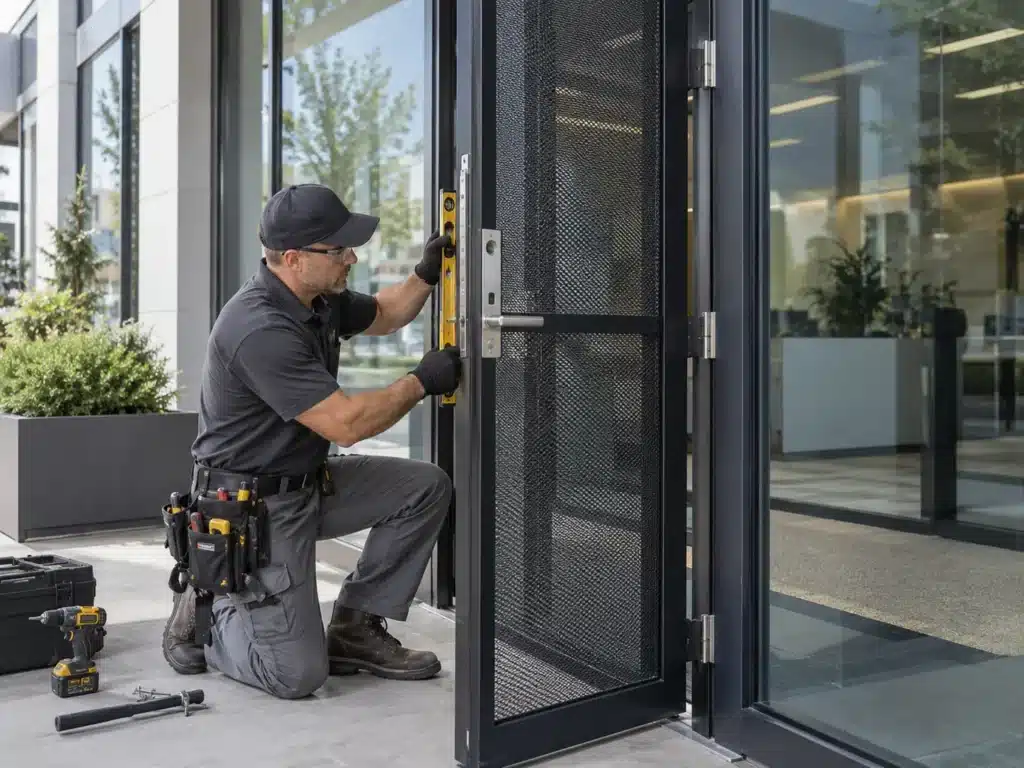
A commercial security screen uses the same high-tensile stainless steel mesh found in our residential installations, custom-fabricated and framed to fit larger storefront openings, aluminum-frame entry systems, and standard office doors.
The mesh is mechanically fastened into a reinforced frame rather than held in place with adhesive or a plastic spline, so the screen resists prying and impact at the points where a storefront is most likely to be tested. Locking hardware can include multi-point locking for doors that need stronger holding power across the full height of the frame.
Storefront Entry Doors
A custom-fit security screen door can be installed in front of or integrated with an existing glass storefront entry, protecting the door and adjacent glass panels without covering the window displays customers rely on to see what a store offers.
Rear and Employee Entrances
Back-of-house and employee doors see far less foot traffic and far less visibility from the street, which makes them a common target. Reinforcing these entries with a security screen closes off a route that is otherwise easy to approach unnoticed.
Interior Office Suites in Multi-Tenant Buildings
Offices inside a shared building often rely entirely on the building’s exterior security. A dedicated screen on the suite’s own entry adds a layer of protection that does not depend on what happens at the building’s front door.
Security Screens vs. Traditional Commercial Security Measures
Business owners typically compare a few options when securing a storefront or office entry. Each comes with real trade-offs worth understanding before choosing one.
| Security Option |
Daytime Storefront Appeal |
Typical Best Use |
| Security mesh screen |
Storefront and display stay fully visible |
Retail entries, office doors, and any opening that needs to stay open or visible during business hours |
| Roll-down metal shutters |
Storefront is fully hidden when closed |
Properties where an obscured storefront overnight is acceptable or preferred |
| Standard glass door and lock alone |
Fully visible, no added barrier |
Lower-risk locations with additional security measures such as alarms already in place |
Many retail and office clients choose security mesh because it is the only option here that provides a real forced-entry barrier while keeping the storefront visible and welcoming around the clock, not just during business hours.