

Quick Answer
What is the difference between multi-point locks and standard deadbolts?
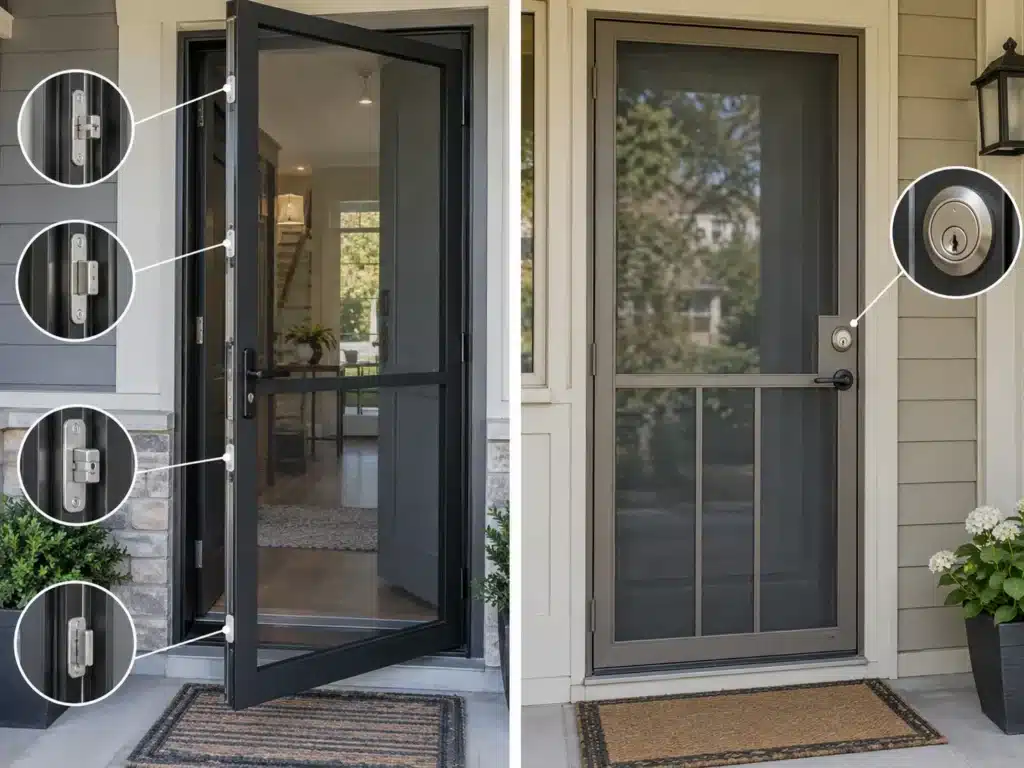
A standard deadbolt secures a door at a single point near the handle, while a multi-point lock engages the frame at two or more points along the door, typically at the top, middle, and bottom. That extra engagement spreads force across the entire frame instead of one spot, making the door significantly harder to kick in or pry open. Security Screen Doors installs security screen doors with multi-point locking hardware for Southern California homes that want stronger protection than a single deadbolt alone provides.
When homeowners think about door security, the lock is usually the first thing that comes to mind. For decades, a single deadbolt near the handle has been the default choice on most residential doors.
Multi-point locking systems take a different approach, and understanding how the two compare can help homeowners decide what level of protection actually makes sense for their entry doors.
The biggest difference comes down to how many points along the door frame are actually engaged when the door is locked. That single detail changes how much force it takes to force the door open.
Security Screen Doors installs security screen doors with multi-point locking hardware, giving Southern California homeowners an option that goes beyond a standard single-point lock.
How a Standard Deadbolt Works
A standard deadbolt extends a single bolt from the door into a strike plate mounted in the frame. When the door is locked, that one bolt is what keeps the door from being pushed or pulled open.
This design has been used for generations because it is simple, affordable, and effective against casual attempts at entry. It is also the type of lock most homeowners are already familiar with.
The limitation is straightforward: all of the holding force is concentrated in one small area of the door and frame.
How a Multi-Point Lock Works
A multi-point lock uses a single handle or key operation to engage locking points at multiple locations along the door, often near the top, the middle by the handle, and the bottom.
Because the door is anchored to the frame in several places at once, the force needed to bend, pry, or kick the door open increases significantly compared with a single-point lock. An intruder cannot simply focus force on one weak spot, because the rest of the door is still held firmly by the other locking points.
These systems are common on Crimsafe security screen doors and other higher-end security products, where the locking mechanism is designed to work together with a reinforced frame and mesh.
Why Locking Points Matter More Than Lock Strength Alone
It is a common misconception that lock security is only about how strong or expensive the lock itself is. In reality, where and how a lock engages the frame is just as important as the mechanism inside it.
A single very strong deadbolt still leaves the top and bottom of the door unsecured. A determined attempt at forced entry often targets the door itself, bending or separating it from the frame near the hinges or corners rather than defeating the lock directly.
Multi-point systems close that gap by distributing resistance across the whole door rather than relying on one contact point.
Hardware Grading Standards
Residential lock hardware is commonly rated under ANSI/BHMA grading standards, which classify locks by durability and resistance to forced entry. Homeowners comparing options can ask their installer which grade a given lock or locking system carries, since this rating provides an independent point of comparison beyond marketing claims.
Multi-Point Locks on Security Screen Doors
Multi-point locking is especially valuable when paired with a Crimsafe security screen door, since the locking hardware and the reinforced mesh and frame work together as a single system rather than as separate, unrelated components.
This pairing is one of the main reasons security screen doors are able to resist forced entry attempts that would defeat a standard screen door or a solid door secured with only a single deadbolt.
Where Multi-Point Locks Make the Biggest Difference
Multi-point locking tends to matter most on doors that see the highest exposure to forced-entry attempts, including:
- Front entry doors, which are the most common target for forced entry
- Side and rear doors that are less visible from the street
- Patio and French doors with larger frames and multiple panels
- Doors on ground-level units in multi-family or rental properties
These are also the doors where a single-point deadbolt is most likely to be tested by an intruder looking for the path of least resistance.
Everyday Convenience Is Not Sacrificed
A common concern homeowners raise is whether a multi-point lock makes a door harder to use day to day. In practice, most multi-point systems are engaged with the same single motion as turning a handle or key, so the extra security does not translate into extra effort for the homeowner.
The added complexity is on the inside of the door and frame, not in how the homeowner interacts with it each time they come and go.
Do You Need to Replace Your Existing Deadbolt?
A standard deadbolt is not necessarily a problem on its own, especially on interior doors or lower-risk entries. The bigger opportunity is usually at the primary entry points into the home, where a security screen door with multi-point locking can be added in front of or alongside the existing solid door.
This approach adds a second layer of resistance rather than requiring homeowners to replace hardware that is already working.
Choosing the Right Locking System for Your Home
A single deadbolt and a multi-point locking system are not solving exactly the same problem. One secures a single point; the other secures the entire door. Homeowners deciding between the two should think about which entry points see the most exposure and how much additional protection makes sense for each one.
Add a Stronger Lock at Your Home’s Entry Points
A multi-point lock spreads protection across the whole door instead of concentrating it in one spot, and that difference matters most at the doors your home relies on every day. Security Screen Doors installs security screen doors with multi-point locking systems for homes throughout Southern California. Contact us today to find the right locking solution for your entry doors.